BISP 8171 Eligibility 2026 – Who Qualifies, CNIC Status and Next Steps
Are you unsure whether your family qualifies for financial assistance through the Benazir Income Support Programme (BISP)? Perhaps you have completed an NSER survey but haven’t received an eligibility confirmation. Or your household may have been declared ineligible even though your financial circumstances are difficult.
Understanding BISP 8171 eligibility 2026 begins with knowing how the government assesses households and what information influences its decisions.
BISP does not approve applicants based only on their monthly income or an online questionnaire. It uses household information collected through the National Socio-Economic Registry (NSER), government verification systems, and the eligibility rules of the relevant programme.
This guide explains who may qualify, why a household might be ineligible, how to understand official status information, and what steps to take when your family circumstances change.
Independent Website Notice: EhsaasProgram.org.pk is not affiliated with BISP or the Government of Pakistan. We cannot access beneficiary records, change eligibility decisions, or guarantee financial assistance.
BISP 8171 Eligibility Check – November 2026 Guide
Information verified: November 14, 2026.
If you want to check your BISP eligibility in November 2026, use the official 8171 verification service.
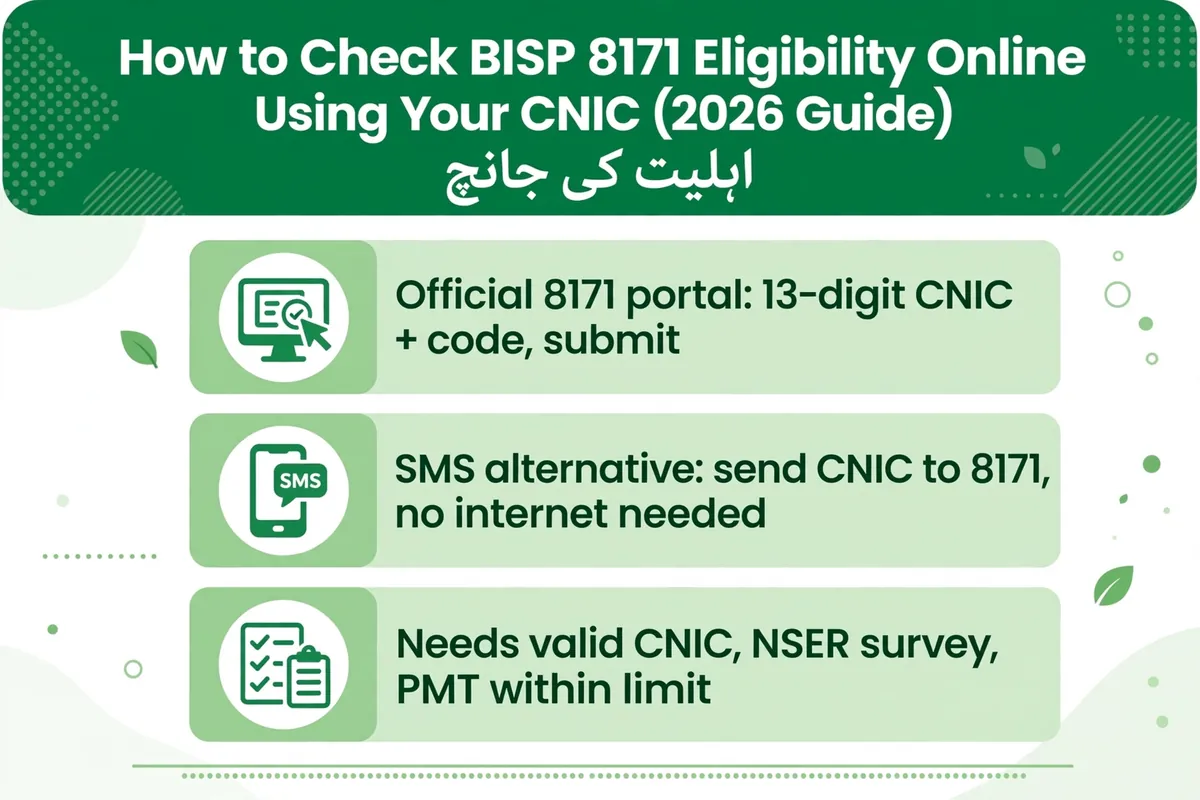
How to Check Your Eligibility
- Visit the official website: https://8171.bisp.gov.pk/
- Enter your 13-digit CNIC number.
- Complete the verification code displayed on the screen.
- Submit the form and review the available status information.
Alternatively, you can send your 13-digit CNIC number to 8171 via SMS.
Important Payment Information
BISP payment amounts, schedules, and eligibility conditions may change based on government announcements.
Always verify current payment details through official BISP channels before visiting a payment collection center.
Disclaimer: EhsaasProgram.org.pk is an independent informational website and is not affiliated with BISP or the Government of Pakistan.
Who Is Eligible for BISP 8171 in 2026?
The Benazir Kafaalat programme provides financial assistance to households identified as eligible under BISP’s assessment rules. Eligibility generally involves a combination of household assessment, identity verification, and programme-specific requirements.
| Household assessment | Socio-economic information is evaluated through NSER. |
| PMT assessment | The household must meet the applicable eligibility rules. |
| Identity verification | Required CNIC and family records must be valid and verifiable. |
| Beneficiary selection | The designated beneficiary must meet the relevant programme conditions. |
| Record accuracy | Household details must reflect actual circumstances. |
| Government approval | BISP makes the final eligibility decision. |
Financial hardship may be relevant, but it does not automatically qualify a household. Likewise, receiving assistance in the past does not guarantee continued eligibility if the government requires reassessment.
How BISP Determines Household Eligibility
BISP uses the National Socio-Economic Registry to maintain information about households across Pakistan. This information helps authorities understand living circumstances and identify families that may need financial support.
Household Income and Employment
Income sources and employment conditions may contribute to the overall assessment. For example, a family relying on seasonal employment may experience financial uncertainty that is different from a household with stable income. However, no independent website can determine eligibility using monthly income alone.
Household Size and Dependants
A household supporting children, elderly relatives, or family members with additional needs may face different financial pressures. Family composition is relevant to understanding household circumstances, but having more dependants does not automatically guarantee approval.
Housing and Assets
The NSER assessment also considers information about living conditions and household resources. Applicants should provide accurate information rather than assuming that owning or renting a home automatically determines eligibility.
Identity and Family Records
BISP uses official identity verification, including information maintained by the National Database and Registration Authority (NADRA). Incorrect family records, outdated marital information, or identity discrepancies may require clarification through the appropriate authority.
Understanding the BISP PMT Score
The Proxy Means Test (PMT) is used to estimate household welfare based on socio-economic information. BISP’s published programme documentation describes a PMT scale ranging from 0 to 100. Eligibility cutoffs are established by the relevant government authorities and may vary according to programme rules or approved exceptions. Older BISP Kafaalat guidance refers to a general cutoff of 32 and a threshold of 37 for households with a person with a disability. However, a government announcement dated June 22, 2026, reported an increased eligibility threshold of 60 for BISP in Balochistan. These examples show why applicants should not rely on a single number presented online as a universal eligibility rule. The applicable threshold must be verified against the latest official instructions for the relevant household and programme.
For a separate explanation of poverty assessment, read our BISP PMT Score Guide. For a general household-assessment estimate, you can also use our BISP Eligibility Calculator. It provides an estimate only and does not replace the official BISP decision.
Who Receives Benazir Kafaalat Assistance?
Under BISP’s published Kafaalat arrangements, the programme generally identifies an eligible household and designates a qualifying ever-married woman with a valid CNIC as the beneficiary. This includes women whose circumstances meet the relevant programme requirements, subject to official checks. BISP also has specific inclusion arrangements for transgender persons and certain exceptional household circumstances. These are not blanket approvals. Identity verification, survey requirements, and the relevant policy conditions still apply.
A widow, a person with a disability, or a low-income family should not assume that their status alone guarantees inclusion. The appropriate next step is to confirm how their circumstances are recorded and assessed under the official programme.
Why Might a Household Be Ineligible?
An ineligible result can be difficult to understand, especially when a family is experiencing financial hardship. However, several different situations can affect an assessment.
The Household Does Not Meet the Applicable Criteria
BISP may determine that the household’s recorded socio-economic circumstances do not fall within the approved eligibility conditions. This is an official assessment, not a result that can be changed by filling out a private online form.
Household Information Is Outdated
A family’s circumstances may change after its previous NSER survey. Changes in family composition, marital status, disability information, or other recorded details may need to be reviewed through the appropriate government process.
Identity Information Requires Verification
A mismatch involving CNIC details or family records may prevent the government from completing a required verification. Applicants should ask the relevant authority which information needs correction rather than guessing at the cause.
The Record Requires Further Review
Sometimes an individual may need additional clarification about their survey or beneficiary information. The relevant BISP office can advise whether a record update, verification, or another administrative procedure is available.
Important: Owning a particular asset, having travelled abroad, or being employed should not be described as an automatic disqualification unless a current official rule specifically establishes that condition.
What to Do After Receiving an 8171 Result
The response from the official service determines the appropriate next action. Exact wording may differ depending on the government system and the household record.
| Your household is shown as eligible | Follow the official beneficiary and payment instructions. |
| Your household is shown as ineligible | Ask BISP whether the record needs review or an authorized update. |
| No household record is available | Contact a BISP registration centre about NSER registration. |
| Verification is required | Follow the official instructions or visit the relevant BISP office. |
| Your family circumstances changed | Ask whether a household roster update is appropriate. |
| Payment is not available | Confirm the payment status separately from eligibility. |
An eligible result is not the same as confirmation that an installment is ready to collect. Similarly, completing a survey does not mean financial assistance has already been approved.
A Practical Example
Consider two hypothetical households. Family A has six members and one irregular income source. Family B has four members and receives a regular income but faces different living costs and family responsibilities. Both families may experience financial pressure. However, these limited details are not enough to decide which family qualifies for BISP. An authorized assessment must consider the official household record and applicable programme rules. This is why a simplified online calculator cannot provide a government eligibility decision.
How to Verify BISP Eligibility by CNIC
BISP uses the official 8171 service to provide beneficiary-related status information. Where available, applicants can visit the official 8171 portal and follow the instructions displayed by the government service. The 8171 SMS channel is also used for official BISP communication.
For complete browser instructions, captcha troubleshooting, and SMS guidance, read our 8171 Web Portal Guide.
Only enter your CNIC on authorized government platforms. This website does not provide a government-connected CNIC checker.
What If Your Family Has Never Completed an NSER Survey?
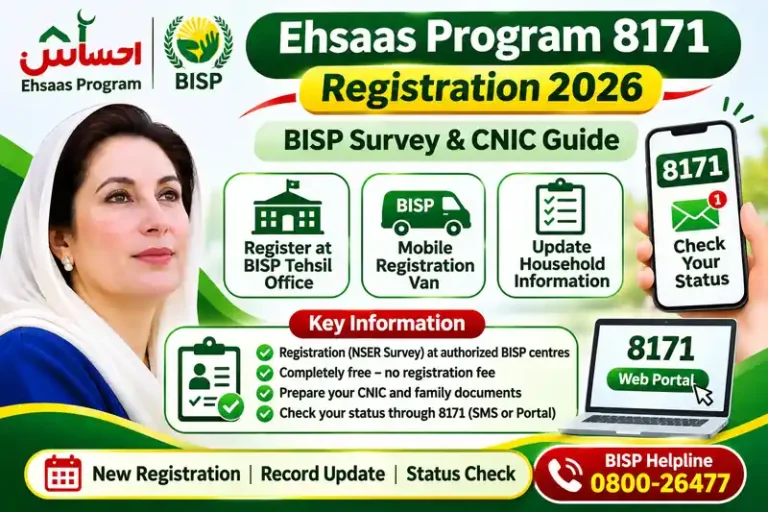
A household without an NSER record may need to participate in the official registration process. BISP conducts household surveys through authorized Dynamic Registry Centres at Tehsil Offices and designated mobile registration services. The process involves identity checks and an interview about household circumstances. Survey registration is free. Keep your original identity documents and any supporting family records available when visiting an authorized centre.
For the complete registration procedure, documents, and household update process, read our NSER Dynamic Survey Guide.
Can an Ineligible Household Become Eligible Later?
Household circumstances can change over time, and BISP has procedures for maintaining and reviewing NSER information. However, a change in personal circumstances does not automatically result in approval. If important information has changed, ask an authorized BISP office which procedure applies. Do not provide false answers, conceal assets, or pay someone who claims they can reduce your official PMT score. An applicant should also avoid requesting repeated surveys without checking the applicable rules. BISP has published restrictions on how soon a household can ordinarily undergo another full survey, alongside procedures for specific updates and exceptional circumstances. The safest approach is to keep identity records accurate and follow official instructions.
Frequently Asked Questions
Does having a low monthly income guarantee BISP eligibility?
No. BISP uses a broader household assessment rather than a single monthly income figure. Eligibility depends on the applicable government criteria.
Can widows qualify for Benazir Kafaalat?
Widows may qualify when they meet the relevant programme conditions. Widowhood alone does not guarantee financial assistance, and identity and household information must be accurate.
What is the PMT score required for BISP in 2026?
There is no single figure that should be assumed to apply to every household without checking current programme and regional rules. BISP’s published guidance includes different provisions and exceptions, including a 2026 announcement concerning Balochistan.
Can I change an ineligible result through an online calculator?
No. Independent calculators cannot access or change BISP’s official beneficiary records. Any legitimate review must follow the government’s authorized process.
What should I do if my official eligibility status is unclear?
Contact an authorized BISP Tehsil Office or the official helpline. Explain your situation and ask whether verification, a roster update, or another process is necessary.
Does eligibility mean my payment is ready?
No. Eligibility assessment and payment release are separate steps. Follow the government’s payment notification and collection instructions.
Official Sources and Assistance
For authoritative information, consult:
- Benazir Income Support Programme — Official programme information, eligibility guidance, and announcements.
- Official 8171 Portal — Government status-checking service.
- Government Press Information Department — Official announcements regarding programme developments.
BISP Helpline: 0800-26477.
Information reviewed: November 12, 2026. Eligibility thresholds, regional exceptions, and administrative procedures may change. Always confirm current rules through BISP.
Disclaimer: EhsaasProgram.org.pk is an independent information website. It is not affiliated with BISP or the Government of Pakistan. We cannot access private beneficiary data, determine eligibility, change PMT scores, or guarantee financial assistance.
9 Comments